
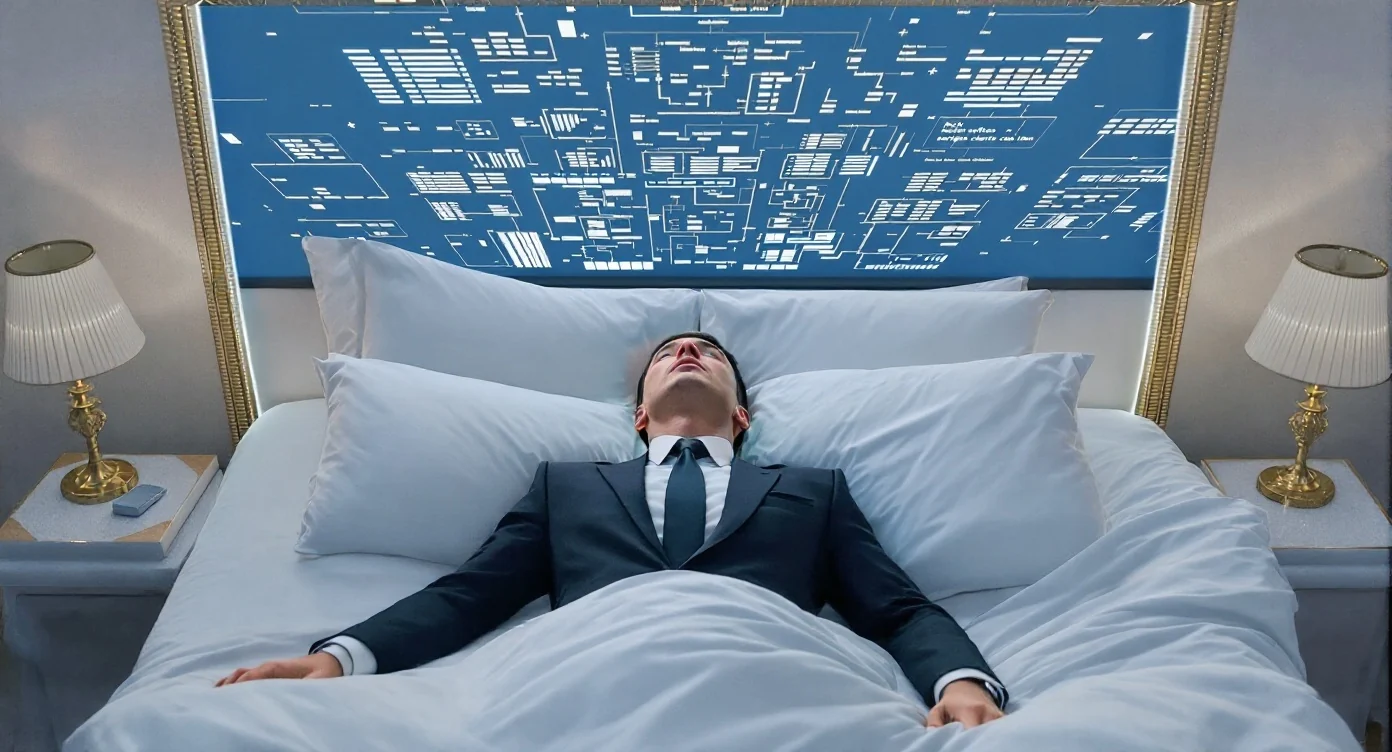
You have tried the meditation apps. You have downloaded the sleep sounds. You have even attempted that yoga class where everyone seemed suspiciously serene whilst you mentally drafted emails during downward dog.
And yet here you are, at 12 pm, lying in bed with your eyes closed but your brain running spreadsheets. Asking yourself the same question: why can't I relax?
If it is any comfort (and I suspect it won't be, because comfort is not really your thing), you are not alone. You're also not broken. You're just running software that was designed for survival, not for Sunday lie-ins.
The Relaxation Paradox: Why Trying Harder Makes It Worse
Here is the cruel joke your nervous system is playing on you: the harder you try to relax, the more tense you become.
Think about it. You approach relaxation the same way you approach everything else: with determination, strategy, and a vague sense that you are probably doing it wrong. You have turned "switching off" into another item on your to-do list, complete with performance metrics.
Meditated for 10 minutes. Felt slightly less murderous. Must try harder tomorrow.
The problem is not your effort. The problem is that relaxation is not something you can achieve through sheer force of will. It is not a court filing you can make or a deal you can close. Your nervous system does not respond to logic, no matter how compelling your arguments.
Research from the American Psychological Association confirms that chronic stress creates physiological changes that persist even when the stressor is removed. Your body has essentially forgotten how to stand down.
Why Can't I Relax and Enjoy Life? The High-Achiever's Dilemma
Let me paint a picture. You're on holiday—a proper one, with beaches and cocktails and absolutely no Wi-Fi (theoretically). By day three, you should be blissfully bored. Instead, you are restless, irritable, and secretly relieved when an "urgent" email gives you an excuse to feel productive again.
Sound familiar?
The question "why can't I relax and enjoy life" haunts high-achievers because somewhere along the way, you biological makeup decided that vigilance equals safety. Relaxation feels dangerous. Enjoyment feels like dropping your guard.
It is actually quite clever, in a deeply unhelpful way. Your brain learned that staying alert, prepared, and slightly anxious kept you successful. Now it refuses to believe the threat has passed.
The Harvard Business Review notes that many executives confuse endurance with resilience, pushing through exhaustion rather than learning to genuinely recover. The result? This dynamic is a primary driver of broader lawyer mental health issues and executive burnout, leaving the nervous system stuck in a permanent "on" mode.
The Five Reasons Your Relaxation Strategies Keep Failing
Before you blame yourself (again), let us examine why everything you have tried has not worked. Spoiler: it's not because you are doing it wrong.
1. You Are Treating Symptoms, Not Systems
Most relaxation techniques try to convince your mind everything is fine, which is great, until your nervous system hijacked the controls three exits ago. If you are dealing with dysregulation, your brain is just a passenger while your body drives. No amount of positive affirmations or picture perfect visual imagery will convince your shoulders to descend from your ears when your lizard brain is 100% convinced a sabre-toothed tiger is waiting for you in the breakroom.
2. Generic Advice Feels Insulting
When someone tells you to "just relax" or "practice self-care," do you want to scream? I do! There is a reason for that. Toxic positivity and generic self care advice do not account for the complexity of your situation. They assume you have not tried, when actually you have tried everything.
3. Your Coping Mechanisms Have Hit a Wall
The strategies that got you here (the over-preparation, the perfectionism, the ability to function on four hours of sleep) used to work. Now they do not. Over time, these subconscious anxiety habits stop working because you have outgrown them. What once felt like a competitive edge now feels like a cage.
4. You're Trying to Think Your Way Out
You are brilliant at analysis. It is how you have built your career. But relaxation is not an intellectual exercise. The body holds the answer, not the mind. And your body speaks a different language entirely.
5. Willpower Is Not the Answer
If willpower could fix this, you would have fixed it years ago. You have willpower in spades. But willpower has limits and your nervous system does not negotiate.
Why Can't I Ever Relax? Understanding Your Nervous System
Let's get slightly technical for a moment (but only slightly, I promise no jargon).
Your autonomic nervous system has two main modes: sympathetic (fight or flight) and parasympathetic (rest and digest). In a healthy system, these switch back and forth as needed. Threat appears, you rev up. Threat passes, you wind down.
But when you have spent years—possibly decades—in high-pressure environments, your system can get stuck. The sympathetic mode becomes your default. Your body forgets that the parasympathetic mode even exists.
The National Institute of Mental Health explains that prolonged stress exposure can alter brain chemistry and nervous system function. Your body is doing exactly what it was trained to do, it just needs retraining.
|
What You Think Is Happening |
What is Actually Happening |
|
"I'm bad at relaxing" |
Your nervous system is stuck in survival mode |
|
"I just need more willpower" |
Willpower cannot override physiology |
|
"Everyone else can switch off" |
Many high-achievers share this struggle |
|
"I should be able to fix this myself" |
Your brain needs new inputs, not more effort |
|
"Relaxation is for people with less responsibility" |
Relaxation is essential for sustained performance |
The Expert's Perspective on Chronic Tension
Dr Stephen Porges, whose polyvagal theory has transformed our understanding of the nervous system, describes this stuck state as a "neuroception" problem. Your body is constantly scanning for danger, even when you are objectively safe. According to his research published in the Journal of Psychophysiology, this is not a conscious choice, it is an automatic response shaped by experience. The good news? Automatic responses can be reshaped. But it requires working with the body, not just the mind.
What Actually Works
Right. You have been patient. You want solutions. Let me offer some approaches that respect both your intelligence and your time.
Start With Safety, Not Relaxation
Your nervous system needs to feel safe before it can relax. This sounds obvious, but most relaxation techniques skip this step entirely. They ask you to calm down without first convincing your body that calming down is safe.
Practical translation: before attempting meditation, try orienting exercises. Look around the room. Name five pleasant things you can see. This tells your nervous system that you are not in immediate danger.
Work With Your Body, Not Against It
If talking about your stress has not helped, there's a reason. Talking is not always enough. Your body stores tension in ways that conversation cannot reach.
Consider approaches that engage the body directly: breathwork, movement, somatic practices. These are not some fluffy alternatives to "real" solutions, they are direct interventions for a physiological problem.
Ditch the Workbooks (Or Use Them Differently)
If you have filled out every anxiety workbook on the market and still feel completely stuck, you are not alone. Workbooks are absolute powerhouses for building insight, they give you the blueprint, the vocabulary, and the "aha!" moments. But insight is not implementation. Workbooks naturally engage your rational, thinking brain, which (as we have established) is not currently running this particular show.
Understand Your Baseline
Many high-achievers do not recognise tension because it's their normal. They have been tense for so long that relaxation feels foreign, even threatening.
Start by simply noticing. Where do you hold tension? Jaw? Shoulders? Lower back? You cannot change what you do not notice.
The Connection to High-Functioning Anxiety
If you are reading this article, there's a reasonable chance you're dealing with what is often called high-functioning anxiety. From the outside, you look successful, capable, perhaps even enviable. From the inside, you are running on a relentless engine of over-preparation and hyper-vigilance.
The inability to relax is a hallmark of this experience. It is not separate from your success, it is tangled up with it. Your anxiety has been your co-pilot, and now you're not sure how to fly without it.
This is particularly common among lawyers dealing with anxiety, where the professional culture actively rewards the very patterns that make relaxation impossible.
A Different Approach: Working With Your Wiring
Here is what I have learned from experience, research and from working with people who share your profile: you do not need to become a different person. You do not need to abandon your ambition or pretend that you are suddenly content with mediocrity.
You need to work with your nervous system, not against it.
This means:
● Respecting your need for control whilst gradually expanding your tolerance for uncertainty
● Acknowledging your achievements rather than immediately moving to the next goal
● Building micro-moments of regulation into your existing routine
● Finding approaches that match your pace rather than asking you to slow down artificially
The Cleveland Clinic recommends building stress management into daily routines rather than treating it as a separate activity. For high-achievers, this integration is essential, you are far more likely to maintain practices that fit your life than ones that require you to become someone else.
The Bottom Line
If you are asking "why can't I relax," the answer probably is not what you expected. It is not about trying harder, downloading another app, or finding the perfect technique.
It is about understanding that your nervous system has been doing its job: keeping you alert, prepared, successful. And now it needs help learning a new pattern.
Ready to explore what that might look like? Start by understanding your own patterns. Notice where you hold tension. Question whether your current strategies are serving you or simply familiar.
And perhaps, just perhaps, consider that relaxation is not about doing less. It is about teaching your body that it's finally safe to stand down.
Book a confidential discovery call — 30 minutes, private, no obligation.
This content is educational, not therapy, counselling, or medical advice. Coaching does not diagnose, treat or prescribe for mental health conditions. If you are in crisis or experiencing a mental health emergency, please contact your doctor or local emergency services immediately.